<i>London Reviews</i>
London Reviews
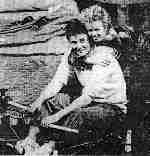
Pawns in a moral fable
Endless hype, rubbernecking
crowds, and cheers to raise the roof--notwithstanding all this,
Chess turns
out to be a fine piece of work that shows the dinosaur mega-musical
evolving into an intelligent form of life.
The usual tactic in
this form of
entertainment is to draw on every orchestral and technical device the
modern theatre has to offer so as to brainwash the audience into the
illusion that
they are witnessing a great event.
As this piece approaches its climax with thunderous reprises of Sweden's
answer to "Land of Hope and Glory",
something of this old habit persists; but for most of the way, the show
deploys its armoury of resources to putting over a stronly imagined
fable with
wit, panache, passion, and a strong moral centre.
Suggested by
the Fis[c]her-Spassky tournament, Chess follows the careers of
two world
champions--one Russian, one American--from an opening match in Italy to
a showdown in Bangkok. Initially, with a Hindu temple number celebrating
the
origins of the game followed by the arrival of the principals on Robert
[Robin] Wagner's checkerboard stage with the two kings taking their
places on opposite sides of the board, you expect a plot cunningly
geared to the moves of the pieces. It is a false clue.
The real
aim of Tim Rice's book is to present the players as pawns in the
surrounding political game; so that--for the defecting Anatoly--winning
the championship means that he loses his family, and his Western
girl-friend loses her Soviet father.
The conditions of this game
are set up from the start, with Anatoly facing a brattish, fiercely
anti-Communist opponent; on either side are the apparatchiks of Russia
and America, and, separating them, a referee who fits into the scheme as
a priest of chess.
Despite Jacobean theatrical interest in the
game, chess seems the unlikliest subject for a blockbusting spectacle of
this order; and its way of achieving that effect is partly through
straightforward decoration.
Every change of location from the Hindu prelude to the Thai finale
brings out a lavish tourist display. In the last of these, Trevor Nunn
throws in a
complete guided tour of Bangkok, including massage parlours, boxing
queues of delectable courtesans, and more than Anthony Mingella showed
of the city
in a whole night out at the Aldwych.
But this rarely puts any
strain on the narrative which, when its moment comes, invariably emerges
in perfect
focus. Much of the show, indeed, is extremely modest. Benny Andersson
and Bjorn Ulvaeus's score supports much of the vocal line with
unemphatic
ostinators and vamps; and its home style might be called Moog
baroque.
Its main success is in achieving expressive melody that exactly follows
the contours of Rice's lyrics. They occasionally hit the spoken word,
only to rebound instantly into rhyme, but the line lengths get their own
melody
from symcopation based on the singer's thought processes sometimes
stretching out like elastic, sometimes contracting like a clenched fist.
The one narrative miscalculation lies in the treatment of the two
rivals. Anatoly (Tommy Korberg) has a searing top register and is most
plausibly
cast as a thoughtful Russian with his heart in the right place. But he
does not compare in dramatic interest with the ghastly Trumper (Murray
Head),
first seen insulting the folk-dancing welcome committee and going on to
flatten a member of the Press corps.
Head plays him with
obnoxious star
quality, and goes on to give an account of himself in one of the best
numbers of the night--"Pity the Child", but thereafter he fades
out.
Elaine Paige, as a torch-carrying second who switches sides to the
defector, contributes a vocally blazing performance, though emotionally
it counts
for more in her divided duet with the abandoned Soviet wife than with
her menfolk.
--Irvine Wardle, The Times, 15 May
1986
[NOTE: Despite the positive review above from The Times' daily
critic, for two full years the weekly theatre listings in the Sunday
Times contained negative quotes from their Sunday critic's
review (next to last
review on this page). To see the interesting conclusion of this story,
click here.
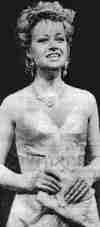
Pawns caught in a counter-revolution
Four large-scale
new musicals have opened in the West End of London in the past six
months.
All have ambitions of a kind. The different between Chess (Prince
Edward) and the others--La Cage aux Folles, Les Misérables
and
Time--is that Chess, give or take a hiccup or two, possess
the musical and dramatic language with which to realise its intentions,
and
they do not.
We praise relatively. Chess makes no attempt to occupy the
astonishing territories of politics and human feeling, resiliance and
sorrow pioneered
by Stephen Sondheim (N.B. one more week of Pacific Overtures in
Manchester, folks, and you'll see nothing like it in London all year),
but it
makes markedly superior theatre to Cats or Starlight
Express and is the best thing of its kind since Evita
opened at the same theatre in
1978. The amplification is contained. An orchestra plays in the pit. Is
counter-revolution around the corner?
An operatta plot which would have delighted the mature Lehar--homesick
international stars in exotic settings forced to choose between career,
country,
family and love--is dramatised in a buoyant, eclectic and stirring
theatre-score by Benny Anderson and Björn Ulvaeus. It is very
European in provenance,
combining pop-balladry with gut-thump disco rhythms (less than on the
original album) and an exuberant range of classical references from
consoling Bach
for the chess games themselves to Schubertian folk-song ("I Know Him So
Well") and Tchaikovsky and Khachaturian for the elaphantine delicacies
of Soviet
sporting diplomacy and its politicised will to win. The music, indeed,
is wittier than the lyrics of Tim Rice, particularly when these are
trying to be
funny.
Chess is set with calculating picturesqueness in Merano and
Bangkok, but the lovers appear unprepossessing and in rumpled, early
middle age.
Anatoly Sergievsky (Tommy Körberg) is the Russian challenger for
the chess championship of the world; Florence, English but
Hungarian-born
(Elaine Paige), is the long-suffering second and lover of Frederick
Trumper (Murray Head), the American champion, committed Commie-basher
and hysterical sob-star.
Anatoly wears a bleak mask of wariness and confusion, as mindful of his
minders as the Americans themselves. Florence is an amused and
courageous
little woman in dull dresses, jeans and shirts, carrying a scruffy mac
or coat over one arm. So where's the romance? Well, Mr. Körberg is
a
complete Swedish singer-actor whose mask dissolves into warm smiles of
humor and affection and who rouses the house with a voice to hurl across
valleys and fervent crescendo key-changes through a rising scale as
effective as any in Sullivan's Lost Chord.
Miss Paige is transformed by Trevor Nunn's direction from the ravenous
tourch singer on the album into a credible and touching figure the
simplicity of
whose singing in most of the show makes even more scalp prickling her
fortissimo flares of burnished sound. Head can do little with the ugly
American
and Körberg, a thrilling recruit to the music-theatre in the West
End, is the indisputable star of the show.
Not everything works.
Trumper fades away in the second half; it is never clearly explained why
Anatoly--who has beaten him, immediately defected and disobeyed
instructions
from both KGB and CIA to lose to the official Soviet challenger sent
after him--should have to leave Florence anyway and go back to his
Moscow wife.
British diplomats are depicted with an evasive facetiousness that
conceals the steely truths of today, and a new number for the Russian
delegation adds nothing to what has already been said about the tearful
ruthlessness of the Soviet machine.
It concludes, however, with
a tiny imaginative detail characteristic of many in Nunn's sharp and
elegant production: the feeble and disconsolate clatter with which empty
plastic hotel beakers, thrown over the shoulder in grim rout and flying
lightly through the air, hit the floor.
Robin Wagner sets the show in a silver and black box enlivened from time
to time by the polyglot babble of 128 television screens, and a
swivelling,
tilting floor. The back wall parts to reveal scenic and architectural
landscapes which describe a global village in which there remains
nowhere--neither the mountains of northern Italy, the streets of an
Alpine city, nor the temple-towers of Thailand--that cannot be submitted
to human calculation and measurement and, one way or another, squared
off. Eash landscape is covered, down and across, with mathematical
lines.
A chessboard, of course, but also a net, a productivity chart, a
cage.
--Michael Ratcliffe, Sunday Observer, 18 May 1986
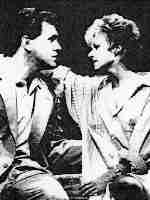
Chess--gift-wrapped and gorgeous
It's as lush as Turandot. Dramatically, as slow-moving as
Parsifal. To look at, as geometrical as a tiled floor. So the
long-awaited new
pop-opera Chess draws up at the Prince Edward, like some
fantastically spangled barouche: it compels admiration but dwarfs
the people within.
You realise in a blink that this gorgeous show, Anglo-Swedish in
inspiration but American-financed in part, has been embellished by
the most lively of Broadway choreographers and the most chic and
stylish of Broadway scenic and costume designers, Robin Wagner
(Annie) and Theoni V. Aldredge (42nd Street).
Accordingly, the chess ballet prologue may be inferior to De
Valois's "Checkmate" but is an eye-popping delight. The book and
lyrics have all of Tim Rice's laid-back knowingness. The tunes of
the Abba men Benny Andersson and Bjorn Ulvaeus may occasionally
sound like anybody's but the orchestrations of Anders Eljas
gift-wrap them in the glint and sparkle of a mountain
stream.
And here is a musical which has something to say. It deplores the
way a noble game may be degraded by international feuding, the
ballyhoo of merchandisers, the voracity of the media and the
ferocious exhibitionism of both players and supporters.
The
astonishingly old-fashioned opening Tyrol scene, all peasant dirndls
and lederhosen, recalls Ivor Novello. But then the championship area
finds the two contestants, a Russian and an American, involved in
underhand tactics and overturned chessboards, to day nothing of a
blackmailing KGB villain and the two players' private batter over
the same woman.
Already stuffed to the gills with plot,
Chess is further crammed to the eyeballs with the kind of
visual stunts associated with the director, Trevor Nunn, who regards
spectacle as the first glamouriser of thought.
On each side
of the stage and behind it, vast sectionalised screens scream
against the actors for attention. Giant TV commentators' faces
alternated with pseudo-newsreel shots of off-stage action or even
films of the USSR's invasion of Hungary. Enlarged chessboards
illustrate the moves, but too fast to be followed. And--most
tiresome of contemporary tricks--even as they are speaking, actors'
heads are seen in video close-up. Overspill is the name of the game:
you don't know where to look.
Riding high overall the hype,
Elaine Paige avidly and resoundingly seizes the star role and turns
in a performance outtopping her Evita--thrilling to watch and
glorious to hear. She plays the hard-bitten Hungarian side-kick of
the loud-mouthed American contender (Murray Head) but falls
precariously in love with the Russian, who is married. After victory
he defects but ends--we are asked to drop a teas--by returning to
the homeland he had serenaded in Tommy Korberg's greatest moment in
the role.
Miss Paige's two best numbers find score, lyrics
and artist in perfect union. "Nobody's Side", a rueful, forboding of
emotional disaster ahead ("Never be the first to believe, Never be
the last to deceive"), and "Heaven Help My Heart", a passionate
soliloquy as she half-realises her lover will probably leave her
stranded.
For the rest the opera (little spoken dialogue) is feebly
characterised and devoid of humor save for a duologue satirising
embassy officials. The girl's
half-hearted Russian comes to life no more than the oaf she
forsakes: these are copybook types. And the synthetic situations
keep repeating the same worthy
message, that the game matters more than the players.
But dramatic development is not possible in a show so over-anxious
to grab your attention with a jolly parade of drum-majorettes, a
picture-postcard
impression of sexy Bangkok or a dazzling solo dancer (Tom Jobe).
Perhaps if Mr. Nunn had been in at the beginning, he might not have
been driven to
swaddle in glittering incidentals the heart of any story: the people
in it, and the excitement of the crises they face.
--John Barber, The Telegraph, 16 May 1986
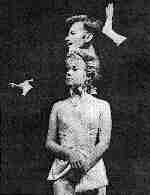
Cue for a song
A musical called Chess and about chess, which never
mentions an English opening, a Tantacour gambit, or any other
chess term indicates a
determination not to get bogged down in the technicalities of
the game.
Anyone going to the Prince Edward who does not
know a rook from a
bishop will have as much chance of keeping up with the plot as a
grand master.
I suspect that it is this distancing of
itself from any true
involvement in its own theme that gave me the impression I was
watching a contrived device rather than a show with a
heart.
Musicals, of course,
are not expected to make any profound statements about the human
condition.
But when they touch upon such complex issues
as Soviet defectors
and human rights, using chess as an illustrative metaphor, one
feels vaguely let down that they are merely excuses for a song
or a production number.
Prestige
The plot is modelled on the various world
championships in which the opportunities for national prestige
by the Russians and Americans take
precedence over the game itself.
Frederick, the American,
is young, rude and arrogant and determined to make himself as
unlikeable as McEnroe in
order to get publicity and more money.
But his tantrums
succeed in driving his Hungarian-born girlfriend into the arms
of his Russian opponent,
Anatoly, and losing him the match.
This improbably
romantic development leads to Anatoly's defection from Russia,
his desertion of his wife and
children and a championship match in Bangkok between the
defector and a new Russian contender.
One gets the
impression that all this moving about
is designed for excuses for production numbers that have nothing
to do with chess.
In the first match in Italy, there is a
lot of alpine costume
dancing which takes one back to The Sound of Music. The
second match provides a more exciting Siamese chorus number with
echoes of
The King and I.
Moody
>BR>
Because the grand masters are either irritating or moody,
usually sunk in gloom about their women or their countries, one
has to look beyond
the plot for any delights from this musical.
There is
some surprisingly clumsy staging by such an experienced director
as Trevor Nunn, but he
can still enchant audiences with a stunning Asiatic mime number
about the history of chess and with startling banks of TV images
which brilliantly
highlight the technological and contemporary nature of the
story.
The music by Andersson and Ulvaeus of Abba is relentlessly
tuneful, running though the action like an operetta and already
proving its popularity by
heading the charts with "One Night in Bangkok" and "I Know Him
So Well. "
Tim Rice's lyrics give the impression of
being mature and witty
wherever one could actually hear them.
Elaine Paige
sounds angelic in her soft numbers but has little opportunity to
let herself go. As Anatoly,
Tommy Korberg displays a powerful voice and Tom Jobe, as the
chess Arbiter, doubles at times as a balletic whirling
Dervish.
Chess has enough excitement to draw audiences but it is
disappointing becuase if it were less mechanical and had more
heart, it could have been
something much more.
--Milton Shulman, The London
Standard, 15 May 1986
Opening move is nearly a winner
In 1981, Tim Rice asked Abba's Benny Andersson and Bjorn
Ulvaeus to work with him on a musical. In 1983, they wrote
it.
In 1984, they released an album of songs from
it. And last night Chess opened at London's Prince
Edward Theatre.
Five years in the arriving, it should
be at least another five before it leaves.
The show
is directed by the Royal Shakespeare Company's Trevor Nunn
and has a cast of 44. Lavishly produced, it has a stage
which rotates, rises, tilts and threatens to roll everyone
on it into the stalls.
The set includes 132 [actually
128] TV screens on which ex-news-reader Robert Dougall makes
a special appearance. Unlike Laurence Olivier's in
Time, his nostrils never run away from his face.
Maybe it's his BBC training.
Although the story
centres on two chess world championships, the sight of
people hunched over boards pondering what to do with their
rooks is kept to a minimum.
Where it does occur, it
is enlivened by them gesticulating a lot and pushing each
other. Far-fetched? Bear in mind that for the 1978 world
championship in the Philippines a cable was specially made
to prevent Karpov and Korchnoi from kicking each
other.
The champion in this show is cynical, nervy,
American and played by Britain's Myrray Head. He wears
training shoes, chews gum and has a rowing machine in his
hotel room.
"Are you an asset to East-West relations?
" the press asks him. "You can not be serious! " he replies.
Does he remind you of anyone?
The challenger, a
Russian, is played by Tommy Korberg. He wears boring
trousers and has bugging equipment in his room. The trousers
do not stop the American's adviser (played by Elaine Paige)
from falling in love with him.
The show is about how
politics and commerce intrude on chess and how single-minded
you have to be to do well at it.
The music ranges
from pastiche light opera to soft rock. Elaine Paige sings
well but is not the star of the show. That honour
undoubtedly goes to Tommy Korberg, whose singing is
outstanding.
Chess is nearly a major triumph, but not
quite. It could do with being a half an hour shorter, and
adding more excitement to the choreography. It is gripping,
eye-catching, but shallow.
I await a draughts,
dominos or tiddly winks sequel.
--David Shannon,
Independent, 15 May 1986
Chess/Prince Edward
It is exactly 100 years since Steinitz crowned himself
the first world champion of chess, and the sport that is
Soviet Russia's chief pastime is now the subject of a
decadent Western musical written by Tim Rice (lyrics)
with Benny Andersson and Bjorn Ulvaeus (music), directed
by the show-biz Shakespearian Trevor Nunn, lit by David
Hersey and designed by Broadway's Robin Wagner (sets)
and Theoni V. Aldredge (costumes).
The first half is set in the Italian mountain village of
Merano, the second in the hotels and temples of Bankok.
The Sound of Kismet, in fact, would not be too
sarcastic a description, for the cold war of a
Red-bashing temeramental American champion and the warm,
well-behaved Russian challenger is merely the background
to a rather muddled romantic story involving Elaine
Paige as Florence, the American second, who falls in
love despite conflicting ideologies. Elton John's
"Nikita" video said it all more pungently in five
minutes.
The story was confusing on the original album--which
contains two first class chart-toppers, "Bangkok" and "I
Know Him So Well"--and Mr. Nunn and company still fail
to elucidate why the Russian wife of a challenging
Anatoly is such a pain, what exactly is the political
manoeuvring behind behind the exchange of Florence's
father (not seen by her since she fled Budapest in 1956)
for the Soviet redemption of Anatoly; or why Murray
Head's histrionic mixed-up kid of a defeated champ
should turn up in Bangkok as turncoat media commentator
before feeding tips to Anatoly on his Indian
defence.
In Bangkok, Anatoly is playing a new challenger (a
Soviet nonentity whom we never see [incorrect, he is in
the "Soviet Machine" number]) having defected to England
for love of Florence. In Mr. Head's first act tantrums
there are echoes of Bobby Fischer's behavior in the 1972
championship, and elsewhere the plot contains obvious
echoes of Karpov and Korchnoi. But Korchnoi's complaint
never ran to reprising a lot of Abba-style deadwood
recitative that only reminds one of how good Jesus
Christ Superstar was in that respect, and how
dated and dramatically inert much of this
sounds.
Unhampered by any such misgivings, Mr. Nunn transforms
the material into a fine spectacle of chorales, operatic
domestic scenes and Evita-like bobbing company
tableaux, none of it as brilliantly distinctive as Hal
Prince's work on the latter show, all of it superbly
sung and above all, lushly orchestrated and ingenously
manufactured through the sound system.
The stage
lifts and tilts, the squares light up in bars and for
the climactic all-Russian match, by now relegated to a
diplomatic charade in the love triangle, the company
assemble in severe black and white costumes intoning the
names of past grandmasters through to Petrosian and
Spassky.
The one performance that stands out is
Tommy Korberg's as Anatoly, an immediately sympathetic
performance that free-wheels expertly through the Abba
whirligig of crashing chord sequences to register a
defiant cry on behalf of which there are too few, you
recall that Mr. Nunn's last anti-Soviet musical,
Every Good Boy Deserves Favour (with Messrs
Previn and Stoppard) gave impassioned expression to the
dissident's plight.
The proceedings are monitored
and supervised by Tom Jobe as an athletic Arbiter who
makes the most of his item with the other judges even if
he does resort to outrageousness. It is hardly his fault
that he resembles a disco-dancing Scandinavian maniac in
the Eurovision Song Contest. The diplomatic wheels are
oiled and then clogged by John Turner as the Russian
second, Kevin Colson as a broadcasting
executive.
The media hype and pressure on the
contestants is conveyed by a battery of TV screens (all
128 of them, that is twice times the 64 squares) and the
excited introductions by none other than former
newscaster Robert Dougall (the admirable fellow who gave
up reading the news because it was all so
terrible).
Miss Paige, as usual, sings fit to
burst, but she lacks a clinching element of emotional
warmth (and should change her hairdresser), a quality
you feel unthriftily squeezed out of Siobhan McCarthy's
impenetrable spurned wife. Still, their duet confirms
the song as one of the best pop numbers in recent years,
thrilling in its undercutting syncopations, melodic
thump and structure.
The show is extremely
theatrical but, paradoxically, lacks a true sense of
theatre, as signalled by the ornate Chinese ballet
prelude, a needless device echoed by the relaxed Thai
jinks after the interval. Not too many complaints about
Mr. Rice's lyrics this time, some of them of almost
Gilbertian wittiness.
--Michael Coveney, Daily
Mail, 15 May 1986
Tim Rice gives us a square deal
Tim Rice has a journalist's nose for a good story.
His style is to encapsulate the complexities and
subtleties of a vast theme in a short and snappy
idiom, to render it instantly accessible to a
mass-circulation audience.
It is therefore,
both bold and courageous to make a musical out of
the cerebral and sedentary game of chess and use it
as a metaphor for the sinister brinkmanship that
afflicts the East-West conflict.
But to the
man who helped the British musical come of age with
such unlikely subjects as Jesus Christ and a
half-remembered Argentine folk heroine, such a
robust challenge should not surprise us.
And, given the media hysteria that now turns
even chess into a gladitorial contest between the
superpowers, Mr. Rice's journalese way with a lyric
could not be more fitting.
Where others might
struggle to show off with a dazzling rhyming scheme,
he is quite prepared to make use of everyday words
like "nice" and "nasty. "
Heroine
"Who
needs dreams? " sings one of his anguished
contestants. "Once I had them, now they're
depressions. Hopes became needs and lovers
possessions. " [well, he almost got it
right]
I can think of no more vivid lament
for the high price of fame and go-getting.
As
hardly a word is spoken rather than sung, Mr. Rice
is, of course, fortunate to have teamed up with
Messrs Andersson and Ulvaeus, late of Abba, who have
supplied music that is always tuneful and has
occasional moments that are incandescent in the
memory.
Yet for all its virtues there is a swings and
roundabouts feel to the evening and although it wins
on the strength of its ambition and some fine songs,
there are losses, too, some of them quite
needless.
If, for example, you have as a
heroine a woman whose potent personality is enough
to make the American lose his game and the Russian
to lose his marbles, she must be given star
treatment in musical terms.
Elaine Paige, who
has a voice you can hear across London, has proved
she can dominate a stage with the best of them. But
she is not helped in her task here, indeed, she
might be a woman who has just parked her Tesco
trolly in the wings and pops out to check the meter
for all the impact her entrance makes.
A
firmer step from director Trevor Nunn might have
helped elsewhere. The show is far too long and the
quaintly Ruritanian revels which preceed the coming
of the two champions belong to the era of the
musicals Mr. Rice helped to bury.
I could
have done without the silly rock and roll romp
before they settled down to the serious business of
the game, too. Speaking of which brings me to the
battery of technology assembled on the
stage.
Triumph
To point up the media hype
with banks of TV screens is fine. But any actor
having to perform in front of dozens of blown-up
images runs the unenviable risk of upstaging
himself.
This happens all too often to Murray
Head, the John McEnroe of Chess. Tommy Korberg is
luckier in having some lung-swelling solos to
perform on a relatively empty stage.
The
whoops of the star-studded first night audience
emphasised his triumph.
--Jack Tinker,
Daily Mail, 15 May 1986

When pawns mean politics
International politics face the music in
Chess (Prince Edward) an ambitious new
musical by Tim Rice and Abba's Benny Andersson
and Bjorn Ulvaeus, that just happens to be
graced with the catchiest new score I've heard
in years.
The music, a tuneful amalgum of
operetta, hard-rock, soul, disco, and mainstream
Broadway, is its strongest asset, and works
miracles in diverting attention away from the
flaws in the muddled plot.
On the
surface, it is about a chess match between a
Russian (Tommy Korberg) and an American (Murray
Head) and the rivalry that develops between
them, especially when the American's girlfriend
(Elaine Paige) defects emotionally and falls in
love with the Russian.
The Russian, in
turn, uses the championship (set in Merano,
Italy) to defect, abandons a wife and two kids,
and seeks asylum in Britain. Eventually, though,
he returns to the old country and his
family.
Tim Rice clearly sees the rivalry
between his adversaries in a broader context
than the surface narrative, and the show is
conceived as a metaphor for the dominance sought
in the political arena by the world's two major
powers. As for the chess players themselves,
they are merely pawns in an all-too-familiar
game of East-West politics.
Hardly a
shattering premise.
But as imaginatively
staged by Trevor Nunn, with good-looking
choreography by Molly Malloy and dressed in
high-tech sets by Robin Wagner, including 128 TV
monitors dazzlingly synchronised, professional
sleight-of-hand scores a triumphant victory of
style over content.
And if, on occasion,
the show's pace is redolent of a chess match
itself, the music as I say, is always a
palliative.
It is powerfully sung by
Tommy Korberg, the undoubted star of the show,
with vigorous vocal support from Elaine Paige
whose way with a song, as we all know, could
shatter plastic. What a shame she does not have
a stage presence to match.
--Clive
Hirschhorn,
The Sunday Express, 18 May 1986
Chess: the losing streak
What I do not understand about Chess
(Prince Edward) is why it needed Trevor Nunn
to direct it. On the face of it, why not?
Here is a big, swanky musical, by Tim Rice ,
and Benny Andersson and Björn Ulvaeus
of Abba, about East-West confrontation in
the world chess championship. On my left,
the American title-holder, Frederick Trumper
(Murray Head), and his glamorous second,
Florence (Elaine Paige). She is
Hungarian-born, having lost her parents in
the uprising of 1956 when she was
five.
This gives a certain piquancy
to having on my right the Soviet challenger,
Anatoly Sergievsky (Tommy Körberg), and
his sinister second, Molokov (John Turner),
who is clearly run by the KGB. Anatoly is
calm and nobly brooding; Frederick is
temperamental and loutish. The championship
is stormy. Frederick resigns. Anatoly
defects. (Why? Ed.) Never mind. Frederick,
we find, is loutish because he comes from a
broken home. Florence laments the fall of
Budapest.
It is beginning to sound as if the thing had
some bearing on real life, but the illusion
is short-lived. Act II. Enter eight Buddhist
monks and dance. This must be Buddhapest.
No: it is Bangkok. The world title is
defended by Anatoly (now UK) and challenged
by a Russian whose identity is unclear.
Anatoly now lives with Florence. Enter
Molokov and his KGB attendants with bugging
devices and revolvers; they drink heavily
(Molokov cocktails?) and dance niftily.
Meanwhile, the Americans enjoy massage
parlours and other decadent things. The
Russians tip generously. The Americans do
not. The Americans trap Anatoly into a TV
appearance where he is interviewed about his
defection, and the wife and children he left
behind, by none other than the ex-champion,
Frederick. (All a bit incredible, isn't it?
Ed.)
Well, yes, especially the end. The US and
the USSR plot together to get Anatoly to
lose,
otherwise his family will be in trouble.
They enlist Florence's help by telling her
that
her father's still alive in a Soviet jail,
and... (You are making this up. Ed.)
All right, I won't reveal the end. But the
fact is that this is a shallow, improbable
story masquerading as a serious musical. Its
politics are carefully tailored to be
equally, and only mildly, offensive to both
sides. A political charade ends up as an
apolitical idyll with a Touching Human
Ending: Rambo on a chess-board.
The staging has a huge high-tech expertise
(multiple TV screens, hydraulic chess-board
floor with transparent panels): it needs a
technological MC rather than one of the
world's foremost directors of classical
drama. The acting is passable. The music is
witty and accommodating; it imitates too
many styles to have any real character of
its own. Sometimes it sounds as if
Khachaturian had written something for a
Palm Court orchestra. Murray Head's singing
is like sandpaper, and his voice can't even
approach the higher register without
cracking hideously. Tommy Körberg, from
Sweden, is personable and pleasant. Elaine
Paige dominates the scene, which is what
you'd expect from a diminutive Hungarian,
and her voice soars birdlike, with an acid
edge and a warm sensual chuckle: steel and
honey.
--John Peter, The Sunday Times, 18
May 1986
[NOTE: Despite the positive review from
The Times' daily critic, for two full
years the weekly theatre listings in the
Sunday Times contained negative
quotes from this review. To see the
interesting conclusion of this story, click here.
How Rice's pawn show ends in
stalemate
I first heard
Chess 18 months ago in a concert
version at the Barbican when it was a
series of buoyant numbers linked by
explanatory narration. It was far more
enjoyable then than it is now in a
full-scale Trevor Nunn production and
the reason why is not hard to seek. The
show's libretto lacks plausibility,
fails to move one and simply cannot
carry the political weight eventually
thrust upon it. A musical is much more
than a collection of numbers; to succeed
it has to have a strong, sustaining
dramatic idea (think of My Fair Lady,
West Side Story, Sweeney Todd).
But here it is hard to work out what
that idea is. In the first half, taking
place among the chess set in the
Tyrolean town of Merano, it seems to be
about the temperamental collision
between the patriotic Soviet champ and
his frenziedly neurotic American
rival.
But in the second half,
set in Bangkok after the Russian's
defection to the West, it apparently
becomes about the tawdry
manipulativeness of two political
systems both conspiring to blackmail the
Soviet champion into returning home. It
is not that the show lacks plot (far
from it): what it lacks is a governing
theme that would give it emotional
momentum or even dramatic logic.
Time and time again, one is left
boggling at the theatrical naivete of
the piece and the assumption by Tim
Rice, Benny Andersson and Bjorn Ulvaeus
that the songs alone (there is virtually
no dialogue) will cary the story. When
the first chess championship erupts in
disorder, the moment has no dramatic
weight because you can't quite work out
what happened.
When the Soviet
hero, Anatoly seeks political asylum in
the West by checking in with a couple of
pinstriped twits in the British
consulate, you look on (at least I do)
in rank incredulity. And when Anatoly
goes into a Bangkok TV studio to be
interviewed by his former rival and
goaded about his abandoned wife, you
wonder if anyone in TV history ever
stumbled so dumbly into such a trap. If
this were a play, the air would be rent
with raucous peals of disbelieving
laughter. Why should the dramatic rules
be any different for a
musical?
The show has some decent
numbers. But while they work in a
recording, they make minimal impact in
the theatre because they exist in a
total emotional vacuum. Elaine Paige
plays an Anglicised Hungarian who starts
as the American's second and ends as
Anatoly's lover. Leaving aside the
question of whether a Budapest refugee
could ever fall for a Russian,
Ms. Paige has songs but no character to
work on: her first-act belter, Nobody's
Side, leaves you stonily unmoved because
you don't really know who this woman
is.
And when she and the Russian
come to ballads of regretful parting,
you don't give a hoot because you
haven't seen any tangible demonstration
of their love. Numbers in a musical are
meant to intensify a situation in a way
that words alone couldn't: here they are
more or less pleasurable items whirling
around in a void.
Trevor Nunn as
director and Robin Wagner as designer
are left with the impossible task of
staging a show that has little
connection with observable reality or
dramatic sense (just why the Americans
should be so keen to ditch the defecting
chess-master was never clear to me). All
one can say is that they do the job with
cool efficiency.
The opening
number, a potted history of chess danced
by ivory pieces on black-and-white
squares, looks beautiful. The evocation
of Merano, all lederhosen, dirndls and
White Horse Inn kitsch, is less
embarassing than it might have
been.
And the World Chess
Championship hype is well caught on
banks of TV monitors arranged in
chess-board pattern; though, on a
technicality, it is inaccurate to have
the retired Robert Dougall reading BBC 2
News at a time of Reagan-Gorbachev
summits and, or a moral note, footage of
Hungary in '56 and the Cuban Missile
Crisis seems almost obscene in this
context.
Maybe the show is
telling us that we are all pawns in the
hands of the Russian and American
political chess masters. But such a
message seems defeatist nonsense in the
light of world reaction to the Chernobyl
disaster. In the end one is left with a
clinically efficient production, a
handful of good singing performances
from Tommy Korberg as The Russina, Ms.
Paige as his mistress and John Turner as
his second. But a musical is only as
good as its book and here one is
confronted by an ichoate mess. As H.J.
Byron said, in another context, ''Life's
too short for chess.''
--Michael
Billington, The Guardian, 16 May
1986
| | |